

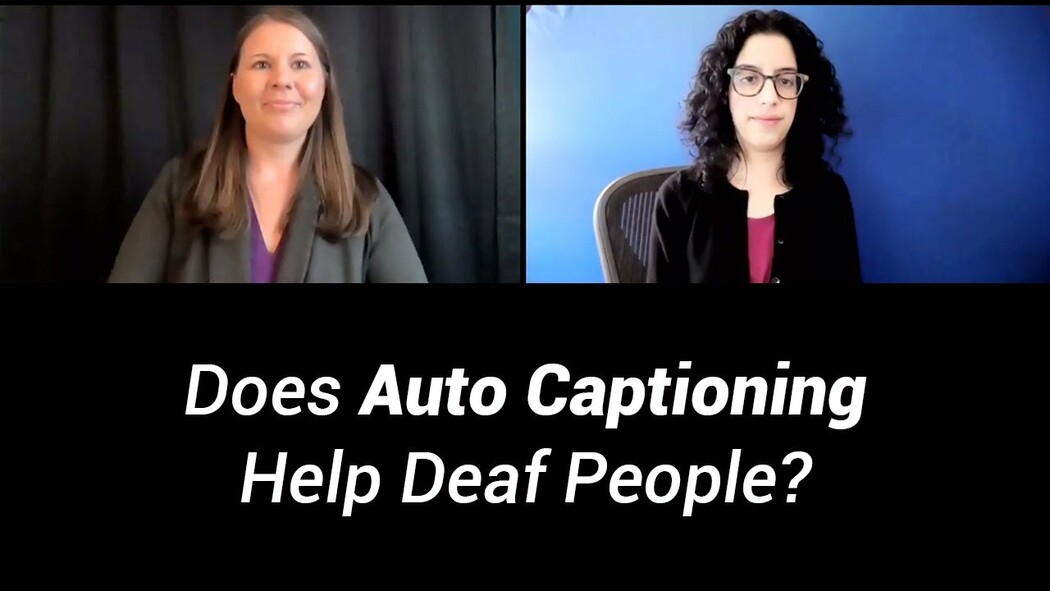
On Demand Webinar: Does Auto Captioning Effectively Accommodate Deaf People?

The image is a split-screen video call display showing two women. The woman on the left has long brown hair, wearing a dark blazer over a purple top, and is seated in front of a black curtain. The woman on the right has curly dark hair, wearing glasses, a black cardigan, and a pink top, seated against a vivid blue background. Below the video call image is a black bar with large, white text asking a question, "Does auto-captioning help deaf people?"

Module Description: There has been a significant increase in the use of captioning services for online learning due to COVID-19 pandemic, whether for live events or captioning video content. To keep up with the demand, many educational entities have turned to Automatic Speech Recognition (ASR) technology to provide timely accessibility for students. While ASR has seen rapid developments in recent years, the gaps in the technology compromises access for deaf students. This presentation is designed to give answers to commonly asked questions from professionals in education settings. Presenters will walk through key concepts such as effective communication, subjective experience, and institutional responsibility along with practical uses of ASR technology. Presenters will also address pressing issues on the inappropriate application of ASR as a direct communication access tool in educational environments and provide additional resources and guidance on the topic.

Learning Objectives: By the end of this session, participants will be able to:

  • Define “effective communication” as described in the Americans with Disabilities Act (ADA).
  • Compare automatic speech recognition versus speech-to-text professionals

  • Differentiate between CART, C-Print, and TypeWell services

  • Review scenarios to determine whether ASR should be used or not

Badge Information: Module content category – Accessibility Practices

                                                      Earn your Auto Captioning Badge

                                                    Learn more about NDC badges here.

Continuing Education Hours: This OnDemand Webinar is pre-approved for 1 NDC Continuing Education (CPE) Clock Hour and 1 CRCC Clock Hour.

Other Courses

The image depicts five people casually engaging in conversation in a well-lit indoor setting. On the left, a person with curly hair gestures with their hands while seated on a ledge. Next, a person in a red jacket and glasses smiles, facing the group. The third individual, wearing a gray hoodie and red beanie, is holding a smartphone and making a conversational gesture. Beside them, a person in a black hoodie laughs, wearing a backpack. On the far right, another person with curly hair touches their ear, wearing a denim jacket over a red shirt.
PD Clock Hours: 1
Lived Experiences of Deaf People isn’t just an introduction to deaf identity—it’s a call to...
The image shows a classroom setting with two students sitting at desks. In the foreground, a student with long, curly dark hair is seated at a green desk, focusing on papers in front of her. She is wearing a light gray shirt and has a pen resting on the paper.
PD Clock Hours: 1
Your Notes = Someone’s Access. When you take notes for a deaf student, you’re not...
The image depicts a classroom setting with several students seated at desks. In the foreground, a male student with short dark hair is focused on writing on a piece of paper. He is wearing a long-sleeved blue shirt and holds a pencil in his right hand. A silver laptop is open on the desk beside him.
PD Clock Hours: 1
Tests are frequently used within higher educational programs and careers. Many tests are not designed...

Need Help?

Fill out this form to get help from the NDC team.  Can’t see the form below? Click here to contact the NDC team.

National Deaf Center