

Vocational Rehabilitation: Understanding Service Options

At the nucleus of every successful vocational rehabilitation employment goal is a well-delineated individual plan for employment, often referred to as a roadmap of services that lead to employment. By better understanding the myriad services offered by vocational rehabilitation, a deaf individual is better positioned to make informed and self-determined choices about their employment future.
Vocational Rehabilitation: An Introduction

Approximately 20% of the adult population has a disability. Most deaf people do not seek vocational rehabilitation services, but those who do most often want employment-related services or education and/or training to prepare for employment.
Telecommunications: VRS, VRI, and TRS

With technology always seemingly one step ahead of us, it’s easy to confuse the various telecommunication services used to visually connect hearing and deaf people who wish to communicate with each other. Three primary telecommunication services are in use today: (a) video relay service (VRS), (b) telecommunications relay service (TRS), and (c) video remote interpreting (VRI).
Telecommunications: Devices and Software

Telecommunication technology has significantly changed the communication landscape for deaf people. For more than 40 years, text telephones (TTY) and amplified phones were the only options. Today, videophones, smartphones, and instant messaging most often replace TTY as preferred communication tools.
Self-Advocacy: Navigating Disclosure in the Workplace

Deciding how, when, and why to disclose a disability to an employer is an important part of the job-seeking process. The decision can significantly affect one’s ability to obtain and maintain employment. The different stages of the employment process and the potential impacts of disclosure at each stage deserve thoughtful reflection.
Mental Health Care for Deaf Individuals: Needs, Risk Factors, and Access to Treatment
This brief summarizes the research related to mental health care for deaf people.
Cochlear Implants: An Introduction
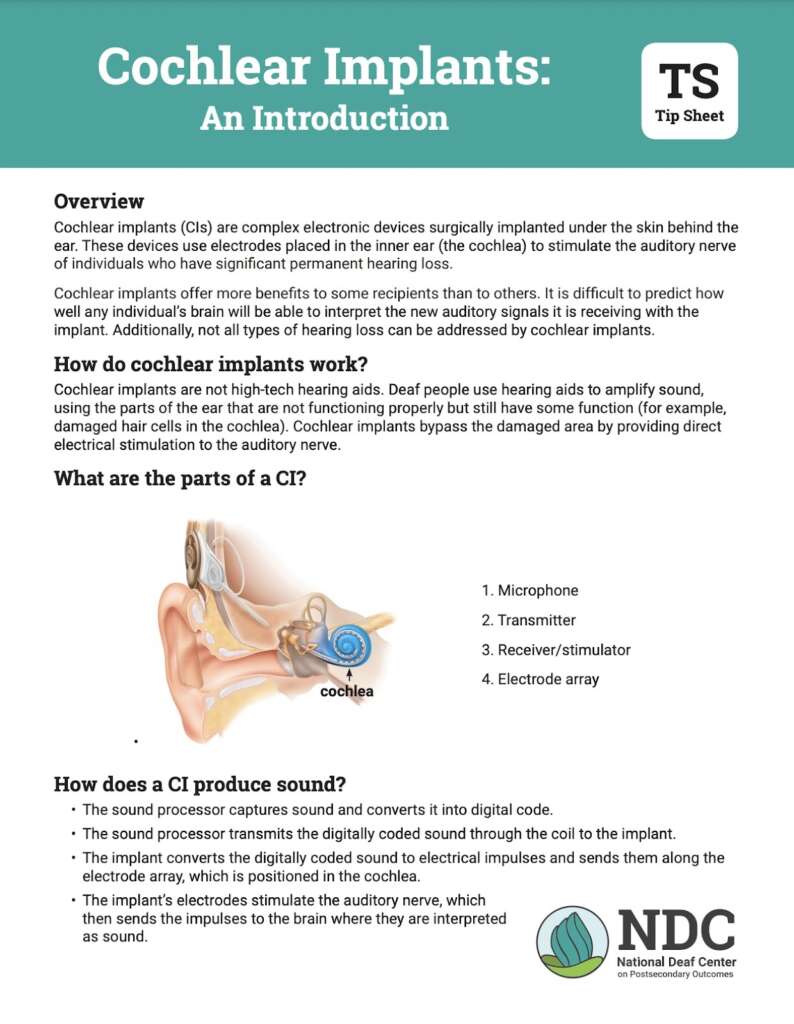
Cochlear implants are complex electronic devices surgically implanted under the skin behind the ear. These devices use electrodes placed in the inner ear (the cochlea) to stimulate the auditory nerve of people who have significant permanent hearing loss.
Including Deaf Students With Co-Occurring Disabilities in the Accommodations Discussion
This study explored how accommodation needs may differ according to deaf people’ additional disability status, if present, through a secondary analysis of the second National Longitudinal Transition Study.
Assistive Listening Systems: Choosing the Right Technology for Your Campus
For those who are new to assistive listening technology, selecting the right systems for a college campus can be daunting. When selecting assistive listening technology for a college campus, institutions should consider a number of factors, including the legal requirements for providing access and the advantages and disadvantages of the various types of systems.
Effects of Parent Expectations and Parent Involvement on Postschool Outcomes for Deaf Individuals

This study assessed whether parent involvement and expectations predicted postsecondary outcomes for deaf people, through a secondary analysis of data from the second National Longitudinal Transition Study.
Impact of Extracurricular Involvement on Postsecondary Outcomes for Deaf Youth

This study assessed the influence of extracurricular involvement on postsecondary outcomes for deaf people through a secondary analysis of data from the second National Longitudinal Transition Study.
The Role of Self-Beliefs in Predicting Postschool Outcomes for Deaf Young Adults

This study explored the role of self-beliefs in predicting postsecondary outcomes for deaf young adults in transition from secondary settings, through a secondary analysis of the second National Longitudinal Transition Study.