

For regularly updated information and resources in response to COVID-19, visit: nationaldeafcenter.org/covid19
[Disponible en español] [Download PDF]
[video:https://youtu.be/bUe6VSXhlps] Video description: https://tinyurl.com/s4m42uk
For many deaf teenagers and young adults, their lives suddenly changed when they were told by high schools and colleges to finish out the spring semester online due to the coronavirus crisis.
Some are at home with parents. Others have to stay with family members, friends, or a new temporary place. For all involved, communication can be a challenge.
Here are seven quick tips for hearing parents, guardians, and hosts to improve communication with deaf children and guests, understand them better, and create a household that’s happier for everyone.
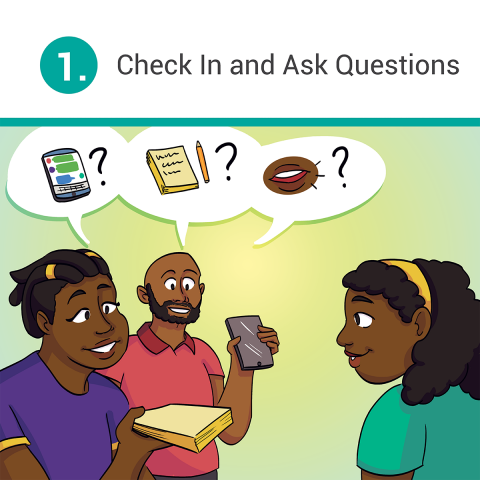
1. Check In and Ask Questions
First and foremost: Check in with your deaf teenager, express your desire and hope to improve communication, and ask them how this can work. Start the conversation with questions, such as “How do you prefer to communicate?” or “What can I do differently to better communicate?” Deaf people know what is best for them. Let them take the lead, then keep checking in periodically.
2. Reduce Assumptions
If the deaf teenager in your home is a guest, don’t assume they can read lips. Deaf people are asked this all the time. Even if they have some residual hearing and can read lips, they have to work harder to understand, which can be exhausting — especially during the stress of a pandemic. Sometimes it can be tempting to ask a deaf person to teach you American Sign Language (ASL). Instead of putting the burden on them, take the initiative to learn basic ASL signs through online tutorials, smartphone apps, or books.
3. Create Space
If space in your home is tight, it will add to everyone’s stress, especially when isolating or sheltering in place. For a deaf college student who lived on campus and was used to their independence, this can be especially difficult. If they don’t have their own room, try to create a private space in your home for them to study and work, as well as unplug. Then, respect their privacy. It will also give you a much-needed break.
4. Take Advantage of Technology
You probably already realized that texting is sometimes the best way to reach any teenager, even when they are at home. You can also use voice-to-text apps on your iPhone or Android devices that transcribe what you say, although they can be imperfect. Or go low-tech: Use a notepad and pen or a small whiteboard to write down messages and questions. When watching television, don’t forget to turn on the captions (even hearing teens love them).
5. Play Deaf-Friendly Games
Finding ways to relax and play together is important in any household. Avoid any games or group activities that are heavily dependent on speaking or listening. Instead, choose deaf-friendly games that rely more on visual cues or physical competition.
6. Make the Most of Your Downtime
Have extra time in your day and already watched too much Netflix? Learn more about deaf people and culture. Take a free online course called Deaf 101, which in just a few hours provides basic knowledge and tools necessary to communicate effectively with deaf people, or check out other online resources.
7. Set Reasonable Expectations
This is a tough transition period — not just for your deaf teenager, but for you, too! Be sure to set reasonable expectations, make time and space for yourself, and continue to have open and honest conversations that respect everyone’s values, perspectives, and uniqueness.