
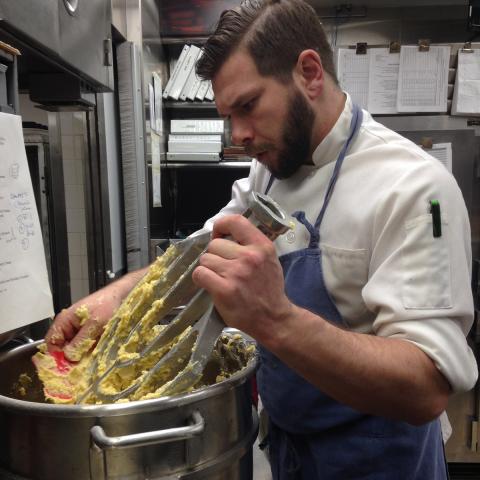
In honor of National Culinary Arts Month, NDC asked deaf chef David Uzzell, who was featured on NPR in 2017, about how he got started in the industry and his advice for aspiring chefs. David has worked at Marcel’s by Robert Wiedmaier, the White House, Reverie, Fäviken and minibar by José Andrés.
How did you get started in the culinary field?
I got into the kitchen after graduating from Gallaudet University. I looked for a job, to no avail. One of my friends had just been hired at a restaurant and asked if I wanted a job. I couldn’t say “no.” The rest is history.
What type of education or training did you need?
I never went to culinary school. What I know, I’ve learned on the job or on my own time. I certainly do see the benefit of culinary school in the sense that it is an all-around education (from baking to technique to working in the school restaurant).
What challenges have you faced that were unique to your field? How did you work through them?
Communication is the biggest challenge that I face in the kitchen. When I started cooking, I would make sure to have pen and paper handy, as well as pushing myself to constantly accommodate others by lip reading.
I remember my first week in a fine dining restaurant, chef asked me to get the Dijon (mustard) and he was confused when I returned with the jar. He then clarified that he was asking for sea salt. I told him the two have a very similar mouth shape. He tried it out and then we had a laugh about it.
That gave way to developing signs with my chefs to refer to specific dishes that were being ordered or to be finished. From there, I’ve come to use Big to communicate with my coworkers and chefs. This helped to facilitate communication when I was working in Sweden, as none of my coworkers had ever met a Deaf person, let alone worked with one.
What advice do you have for deaf youth interested in being a chef?
As I answer this, several thoughts occur to me.
If your high school offers a culinary elective or after-school activity, sign up for it to see if cooking is for you. You can also work in a restaurant. Starting out as a dishwasher is a good way to come to understand the kitchen’s rhythms, and the best dishwashers often will be asked to help with prep, or even cover for someone. From there, they can work their way up the ladder and move onto more prestigious establishments or even work overseas.
Communication will be a constant challenge, teaching and re-teaching your coworkers (and new hires) how to work with you.
Keeping a swivel head is key, as you’ll constantly be receiving information from the chef, your coworkers will be passing behind you with hot food and you’ll also have to keep working during all of this.
Keep a good attitude and be nice to everyone you work with, because you never know where they’ll end up. This adage is equally true in Washington as it is in the kitchen. Better to be remembered by your coworkers as a nice person than as an [expletive deleted], as the food industry can be very close-knit (especially fine dining) and everyone knows everyone.
The hours are long, ten to fourteen hour workdays are common, so it is important to take care of yourself. Sturdy footwear is essential for long days. You’ll likely burn and cut yourself, especially when you start out.
Kitchens, like any other workplace, are a reflection of the people that work there. There is a difference between yelling to teach a lesson and yelling to just be an [expletive deleted], and it’s not easy to tell the difference at the beginning. All too often, young cooks internalize that toxicity, which then takes time to unlearn. It makes all the difference to work with the right chef that will respect and treat their staff well and teach them to be great chefs in their own right.
The same can be said of the lifestyle, as it becomes easy to fall into coping mechanisms that do more harm than good.
Ultimately, it comes down to being willing to work hard, keeping your knives sharp and saying “yes, chef!”