

When a deaf student arrived at Towson University and requested both interpreting and real-time captioning services, the staff’s initial response was: Why both? And the student’s question was why not both?
At the time, the current staff in the Towson’s Accessibility and Disability Services (ADS) Office had not received a request for both. They were used to providing one or the other. But instead of sticking to what had typically been done in the past, the ADS Office paused and asked themselves: Are we really providing what students need?
Learning from Others, Leading with Experience
Amy Pryor, a Disability Specialist at Towson, took the lead in finding answers. They began researching how other colleges handled similar requests and looked into best practices that would truly support deaf students—not just meet the minimum.
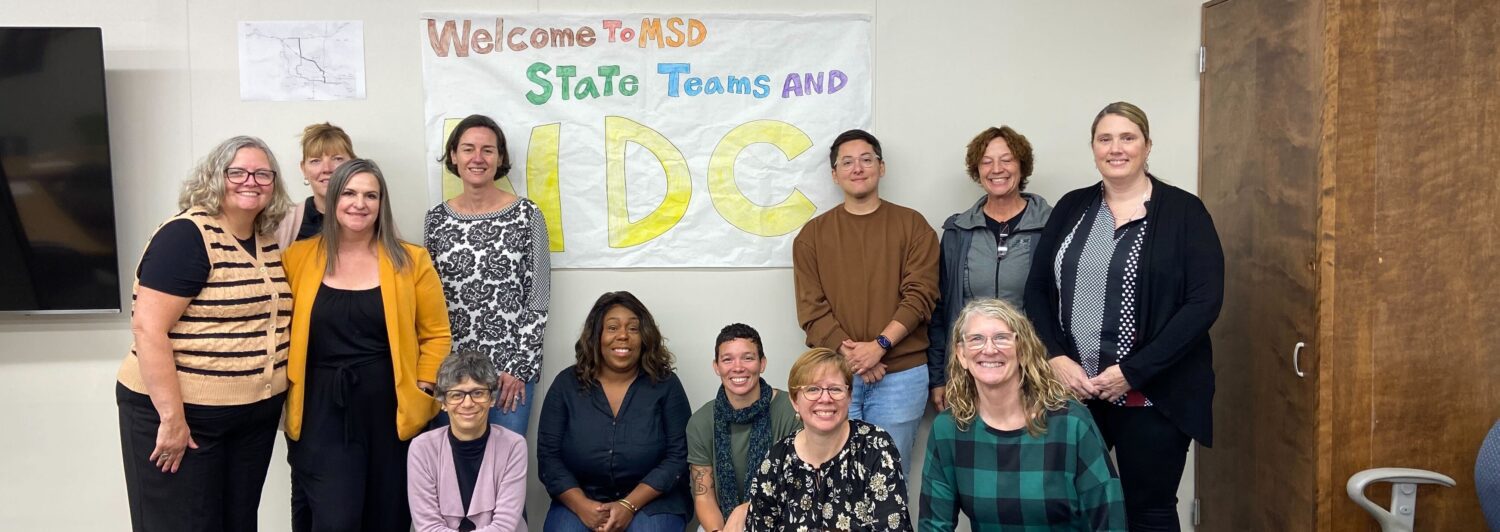
Amy participated in an event hosted by the National Deaf Center (NDC) that brought together disability services professionals who work with deaf students from several colleges. Through training and shared dialogue, NDC helped equip participants with the tools and examples to evaluate accommodation strategies more holistically. It was there that Amy learned the importance of connecting with other colleges that have successfully implemented dual accommodations as a standard practice when appropriate.
This student-centered approach means understanding that access is not static—it can shift over time and across classes to best meet the individual student’s needs. Accommodation decisions may reflect not only the student’s specific access needs, but also the unique demands of each course.
Amy brought those ideas and tools back to the ADS Office at Towson and started a conversation. Amy also shared their own experiences to help others understand that depending on a single accommodation—such as only using an interpreter or only relying on real-time captions—can limit access. In some settings, interpreters may not capture technical vocabulary or concepts, and this type of service typically doesn’t allow for content review or reference, while real-time captions or notes can help fill those gaps. Without both, students may miss key information or have trouble fully participating in class activities.
“Using my own experience, I helped my director understand how much concentration it takes—and then you’re not able to do those other note-taking pieces,” Amy explained.
To help make it real, Amy showed side-by-side examples of AI notetaking recordings and live captioning. That helped the team see what the student experience actually looked like.
A Shift in Perspective
Through open and honest conversations, Towson’s ADS Office came to see something important:
In some cases, using both captioning and interpreting isn’t “extra”— it’s access.
For many deaf students, following along in class with just one type of accommodation isn’t enough—especially when things move fast or get technical. Combining sign language interpreting with speech-to-text services can help students access both conceptual content and English vocabulary simultaneously, which supports effective communication access.
Cost alone can’t be used to deny accommodations.
Under the ADA and Section 504, colleges must provide the communication access a student needs—even if that means offering both speech-to-text services and interpreting at the same time if requested. The only exception is if doing so would cause an undue burden, which is very rare and must be based on the institution’s overall resources, not just one department’s budget.
Real Change—Fast
Towson didn’t wait. Within a single semester, the university:
- Acted quickly to get a deeper understanding of the need for the specific classes being taken
- Approved dual accommodations in multiple courses
Amy explained why speed mattered:
“When a student only has a 16-week course, you don’t have time to wait—the change has to happen right away for them to have access from the start.”
What We Can Learn
Towson’s story shows what happens when a campus listens, learns, and responds—with students in mind every step of the way.
Here are four reminders this story offers:
- Deaf students’ lived experiences are expertise that should guide practice.
- Engaging with professional networks helps discover better ways to serve students.
- Dual accommodations aren’t a luxury—they’re access.
- Deaf students should have a seat at the table when advocating for themselves.
Want to Create Change on Your Campus?
Every campus has the power to do better—and it starts with asking the right questions.
Towson changed their perspective in just one semester. With the information, resources, and commitment, your campus can, too.
Ready to take the first step?
Schedule a consultation with our team, or explore the certificate program to build practical strategies that make a lasting impact.