Unlocking Insights: Exploring Deaf Data with State Reports

Published on March 7, 2024

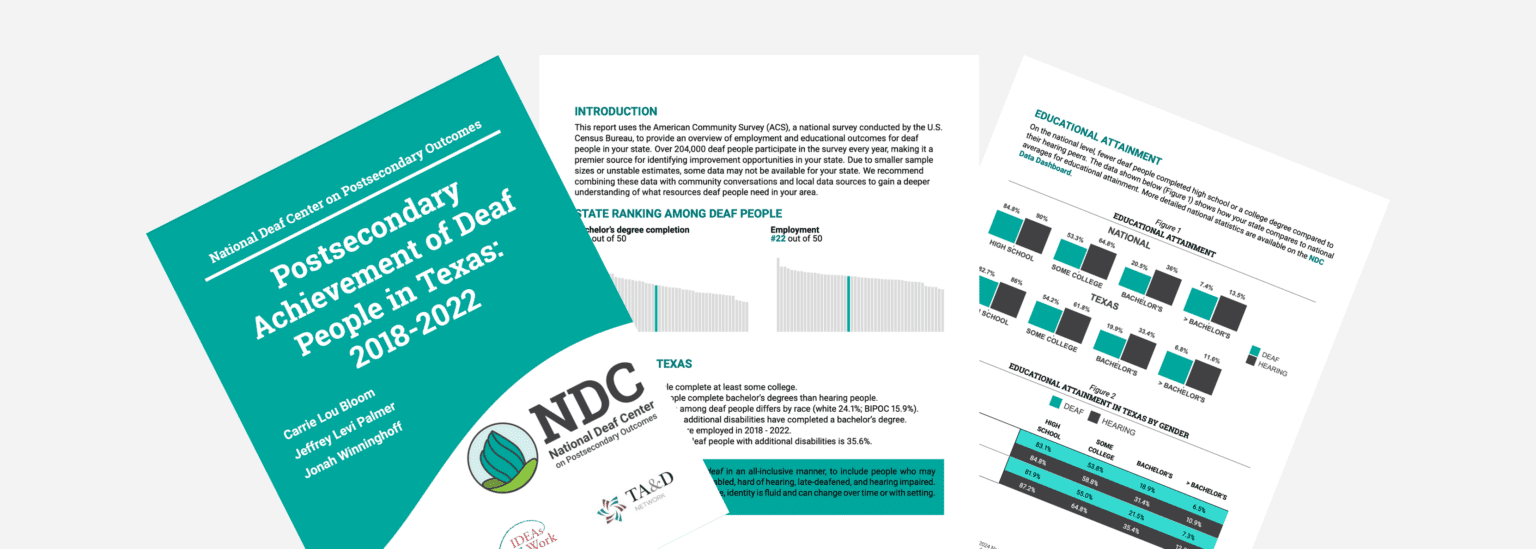
Three document pages titled Postsecondary Achievement of Deaf People in Texas: 2018-2022 feature graphs, charts, the NDC logo, and text discussing outcomes and statistics for deaf students in Texas.

NDC is thrilled to reveal that we’ve updated our State Reports! With the click of a link, you can view and download updated data and gain new insights into the lives and experiences of deaf people in any state across the country.

If you’ve ever wondered about the employment and education statistics for deaf people in your area or how your state compares to others, these reports provide a glimpse into the current landscape. From educational attainment to employment rates, this data offers a comprehensive view of the barriers and successes experienced in each corner of the United States.

Whether you’re an administrator, educator, disability services professional, or simply a curious advocate, this data empowers you to navigate the complexities of deaf-related statistics effortlessly. Knowledge is power and, armed with insights from our State Reports, you can drive positive change for deaf students in your state. You can use this data to demonstrate inequities, highlight employment and educational achievement gaps, identify subpopulations that experience more barriers, and showcase data by race, gender, or disability.

State education and vocational rehabilitation teams, community agencies and organizations, career centers, and colleges/universities who are working with deaf people on education and employment outcomes often rely on NDC data reports. Some states have used our data for citing employment numbers, applying for grants, as well as other purposes. For example, the Nebraska state team used data from the data dashboard to apply for a grant to fund a summer program, the Idaho team used our national level data report in a grant application for their food truck program, and community members in DC used our data to advocate for a Deaf and Hard of Hearing Commission.

If you’d like to contact us for personalized support, especially in regards to data usage, please email our Help Team at help@nationaldeafcenter.org.

Bar chart comparing employment rates of deaf people: Nationally, 52.3% are employed, 43.6% not in labor, and 4.1% unemployed. In Wisconsin, 56.3% are employed, 40% not in labor, and 3.7% unemployed.
Infographic showing education rates of deaf people with some college after high school: National average is 52.6%, illustrated with green caps, and Wisconsin average is 54%, also shown with caps. National Deaf Center logo included.

Empowering Change, One State at a Time

Employment rates for deaf people overall have not improved since 2008, and we want to change that. NDC is inviting teams to our new Career Readiness Program to strengthen and increase competitive integrated employment opportunities for deaf people in your community. Collaborative partnerships are an evidence-based practice in transition—and result in better outcomes for people with disabilities. Whether your team wants to tackle an existing program, start fresh, or simply needs a hand in pinpointing areas of improvement, we’re here to support the process. Learn more about this opportunity today and register for one of the sessions below to get more information and answers to your questions about this opportunity. If these dates and times don’t work for you, please let us know and we’ll schedule a one-on-one meeting with your team.


Ready to embark on a journey of discovery? Dive into our updated State Reports today and turn data into action! We invite you to join us in harnessing the power of information to drive positive change. Together, we can rewrite the narrative and create a future where everyone has the opportunity to thrive in a field they are passionate about.


Save This
Please login to bookmark Close
Useful For: Disability Services Professionals, Higher Education Administrators, Vocational Rehabilitation Professionals

Other News Items

The image shows a composite design with two main sections. On the left, a grayscale side view of a person wearing glasses and looking towards a computer screen, mostly obscured by a textured white overlay. This side is relatively blurred, focusing attention on the right side of the image. The right section features a clear, detailed view of a computer screen displaying a statistical bar chart. The chart is composed of two vertical bars—one teal and the other black—indicating a comparison between two groups, labeled "Deaf" and "All." Numerical values "18" for "Deaf" and "31" for "All" are marked on the bars. The background is green with a dotted white pattern, adding a textured look. A small NDC icon is visible at the lower left corner.
March 16, 2026
Research and Publications, Current Trends
...NDC’s updated Data Dashboard reveals record deaf employment gains alongside persistent workforce gaps, guiding transition supports that expand access to meaningful careers....
A person sits at a marble desk working on a laptop beside an open design book showing color swatches and sketches. Their hands, decorated with henna and colorful nails, rest on the keyboard. A notebook and pen lie nearby, suggesting a creative or design-focused workspace.
November 12, 2025
Online Learning
...Two new NDC modules help campuses strengthen notetaking systems and train notetakers to better support access for deaf students....
A group of seven people are in a professional meeting room. Two women stand at the front of the room, smiling and communicating in American Sign Language (ASL). One woman, wearing a black dress and glasses, is signing while the other, in a black blouse and tan pants, signs back. Behind them is a large flat-screen TV mounted on the wall above a webcam. Five others sit around a long conference table, watching and engaging with the presenters. The table has notebooks, pens, and documents, and the mood appears collaborative and positive.
November 10, 2025
Impact Stories
...Deaf professionals strengthen campus access systems—but too often, they face the same barriers they’re hired to remove....

Need Help?

Fill out this form to get help from the NDC team.  Can’t see the form below? Click here to contact the NDC team.

National Deaf Center