

More and more people are working in healthcare fields – including deaf people. Our analysis of the American Community Survey reveals that over the last 10 years there has been a 72% increase in deaf students enrolling or majoring in healthcare-related fields (U.S. Census Bureau, 2024).
Challenges in Healthcare Fields for Deaf Students
There are many challenges that deaf students face in the healthcare field. Some of these include:
- institutional concerns about cost, logistics, and students’ capabilities
- denial, cancellation, or postponement of accommodations
- canceled enrollment and/or withdrawal of acceptance
- unfounded assumptions, including assumptions of patient risk or peer distraction
- negative attitudes toward deaf people
While not an exhaustive list, it’s clear that these barriers disproportionately and negatively affect deaf students. Challenges like these prove how important it is to ensure that programs for healthcare students are accessible and welcoming for deaf students. Keep reading for helpful resources and to learn more about developing accessible education and training programs!
“The healthcare world is changing. Medical educators are becoming more open to include deaf and hard of hearing people in our field. The workforce is becoming more diverse, which benefits everyone, and benefits the patients as well.”
– Dr. Christopher Moreland
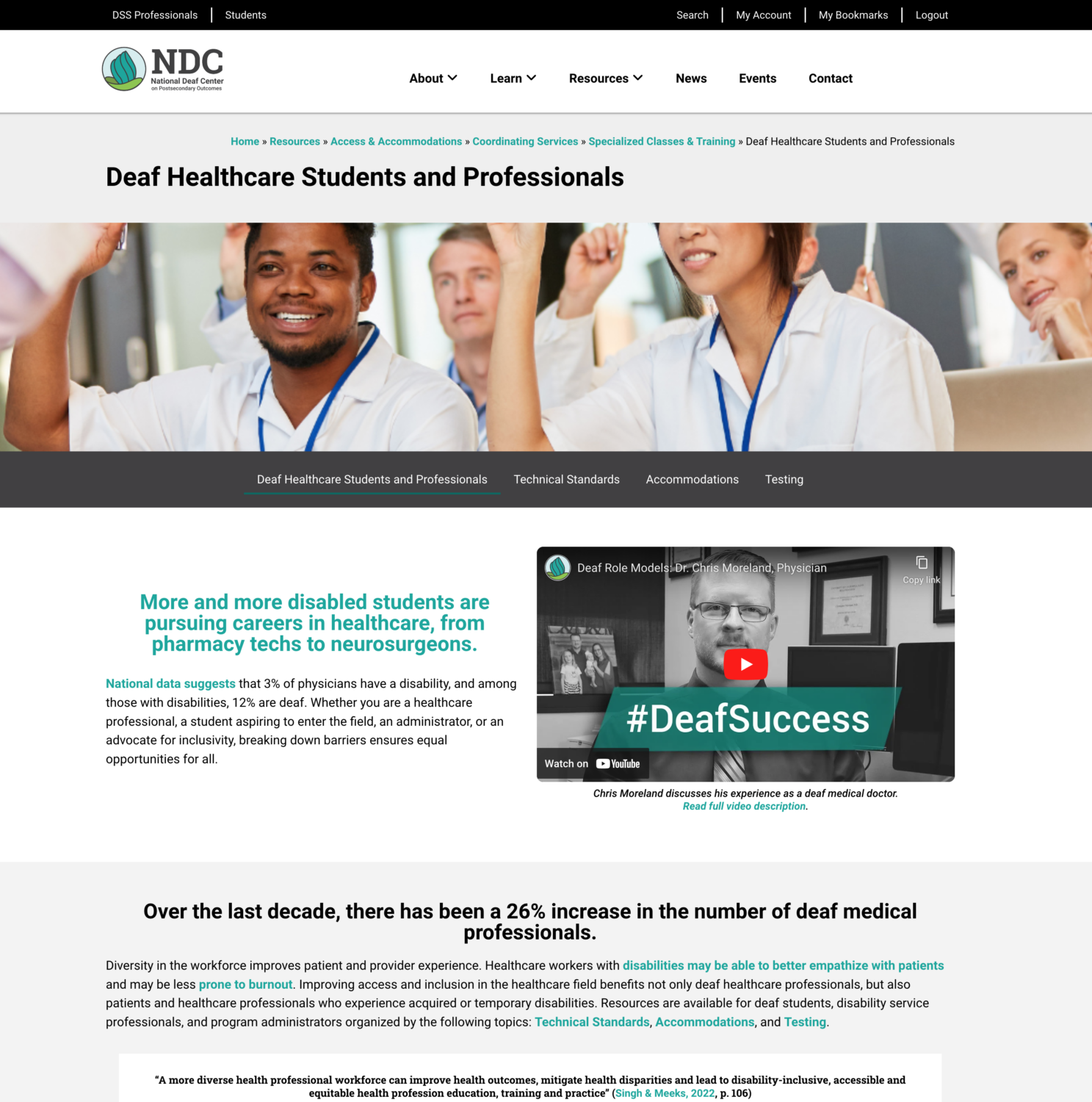
NDC is excited to share a new centralized resource to support deaf students and professionals in healthcare education and training programs!
The Deaf Healthcare Students and Professionals page is designed for deaf students interested in healthcare careers, disability support services (DSS) professionals, and program administrators.
Deaf students interested in healthcare careers will gain access to stories from deaf role models and resources to help them prepare for the admissions process, medical school, and beyond!
Administrators and disability services professionals working with deaf students will better understand their institutional responsibilities, as well as access a variety of tools, resources, and online courses to better serve students.
Healthcare Professionals Playlist
1:58
1:55
0:41
1:20
3:05
0:43
0:43
2:43
1:01
2:45
4:16
4:04
2:45
1:39
How Can You Develop an Accessible Healthcare
Program for Deaf Students?
- Update and periodically review technical standards. Technical standards sometimes have language that unintentionally excludes students with disabilities, and may not be compliant with the ADA. Updating these standards helps ensure that your program is accessible.
- Collaborate proactively across departments. Building relationships inter-departmentally is crucial to ensure access for deaf students. Transparency in policies and practices is key, as well as proactively securing accommodations for events across campus.
- Strengthen relationships between students and disability services. The interactive process between the student and personnel at the disability service office ensures optimal services and consistency which is critical to student success.
- Promote transparency in documentation practices. For students, clearly defined policies and procedures can help with proactive planning, contingent plans for requesting accommodations, and for testing accommodations (such as for the USMLE). Documentation also demonstrates the need for accommodations over a period of time, such as for licensure exams. However, DSS offices should not be relying solely on disability documentation when determining eligibility for accommodations.
- Increase awareness of deaf students, including accommodations, technology, and universal design approaches. NDC has a wealth of modules and webinars to get started or to learn more on specific topics. Additionally, NDC also has a certificate program available that is designed for DSS professionals.
Students, Do You Know How to Build Relationships with
Disability Services and Prioritize Self-Advocacy?
Deaf students just like you are enrolling in healthcare education and training programs all across the country—are all of these programs accessible and welcoming?
As a deaf student in healthcare, you are likely to experience a variety of barriers relating to access, support, and attitudes on campus. Students need to be prepared to advocate for themselves so that they can make informed decisions about their accommodations. Remember: while institutions have a responsibility to provide accessible learning environments, students have an equal responsibility to communicate their needs and discuss any challenges they are facing. It is important to be informed of your rights and to build meaningful relationships with campus allies to ensure that you have the best possible college experience.
Share these resources with staff and admin in your programs, explore self-advocacy tools on our page, and contact NDC at help@nationaldeafcenter.org for more support!
“Clearly, we deaf people have a lot more challenges than typical, but we shouldn’t allow that to stop us. We must keep trying. Even if you fail, get up and try again. You have a full army of people behind you, rooting for you to keep going.”
– Dr. Zachary Featherstone, Pediatrician