
Read the full video description.
October is National Disability Employment Awareness Month (link), NDEAM. This year’s NDEAM comes at a time of great uncertainty for many. Due to COVID-19, the past two years of work life have looked very different. In March 2020, the country went on lockdown. Some of us were fortunate enough to work remotely from home, others were laid off temporarily, and some are still looking for jobs.
The pandemic has affected everyone differently, including disability communities. The Kessler Foundation provides monthly disability employment data and found that during the nationwide shutdown people with disabilities were disproportionately impacted.
Something interesting and encouraging has occurred since 2020, however. The employment rate for people with disabilities has caught up to previous levels, while it hasn’t quite returned to normal for people without disabilities. It could be that employers are providing more flexibility in the workplace and that has given people with disabilities greater access to return to work or find new employment. This is great news — we want to continue this trend!
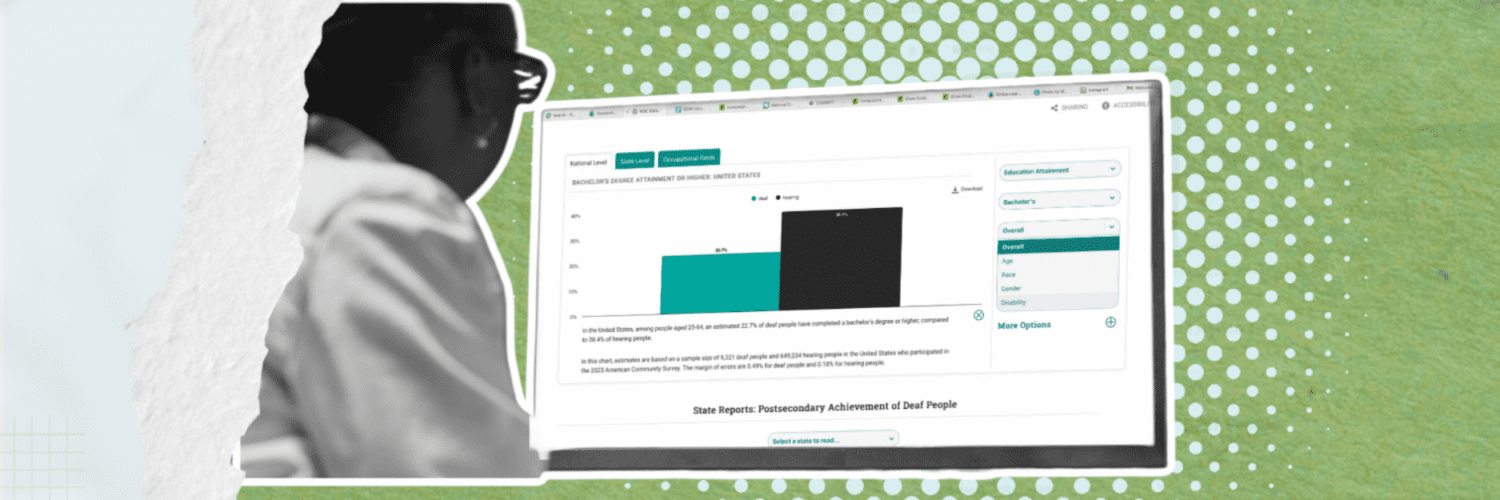
When looking at the deaf community, the National Deaf Center on Postsecondary Outcomes’s (NDC) 2019 report shows inequities remaining between hearing and deaf people. The gap in employment is stark, with 53% of deaf people working compared to 76% of hearing people. The inequities are even greater when we take a closer look within the deaf community, where we can see that deaf people with additional disabilities are impacted to a greater extent. Thirty-five percent of deafblind people and 35% of deafdisabled people work, while 72% of deaf people without additional disabilities are employed.
This shows us that there are still many systemic barriers to employment, and highlights that we aren’t all affected the same. Now more than ever, NDEAM is an important time for us to be thinking about work experiences, job opportunities, and the pathways that lead to successful employment for deaf people and disabled people.
We know the journey to successful employment is complex. Things like continuing education and job training are important, but we also have to think about appropriate accommodations for each job. It also takes community support!
We are all part of this community support in our various roles and communities. Each of us has an obligation to think about how we can contribute to improved job opportunities for deaf people.
Maybe that means an increase in access to deaf role models or mentoring programs. It could mean thinking about what it would look like to ensure that networking opportunities are accessible. We must also look at existing workplaces and seek opportunities for flexibility, so the workplace can be modified to be fully accessible.
We all have a part to play.
NDC is Here to Help
If you have questions or need support, reach out to our NDC help team. We have online resources for you to look at during NDEAM and all year long!