
For regularly updated information and resources in response to COVID-19, visit: nationaldeafcenter.org/covid19
[Disponible en español] [Download PDF]

Video description: https://tinyurl.com/s4m42uk
Deaf teenagers already have a lot on their minds, even before the COVID-19 pandemic. And like all teenagers, they are experiencing lots of feelings of uncertainty, anticipation, and insecurity as they navigate the transition from child to adult. That’s where self-determination can help — during the pandemic and beyond.
What is Self-Determination?
Self-determination is about acting or causing things to happen in your life so that you can reach your goals. There are three parts to it: decide, act, and believe.
And it’s powerful: Research shows deaf youth with higher levels of self-determination during high school are more likely to enroll in college, live independently, have positive self-beliefs, make more money at work, and have more opportunities for career advancement. People who are self-determined are good problem solvers because they figure out how to reach goals at school, work, and home, even when they run into problems.
Setting and making plans to achieve self-determination goals needs to be part of deaf students’ transition planning in high school, which should include the use of well-designed and accessible assessments.
Measure Your Strengths
The National Deaf Center collaborated with Kansas University Center on Developmental Disabilities to translate the Self-Determination Inventory: Student Report (SDI:SR) from English to American Sign Language (ASL).
This online assessment asks about how youth feel about their ability to be self-determined: to make choices, set and go after goals, and make decisions. Designed for youth between the ages of 13 and 22, it takes approximately 10-15 minutes to complete.
When students complete the assessment, they receive a report about their strengths and areas of need, which can then be used to set goals and develop plans.
Tips for Building Self-Determination Skills
During the COVID-19 pandemic, with many schools closed and some transition planning services on hold, instilling and strengthening self-determination skills can be done online at home. Here are six tips.
-
Take the self-determination assessment
This short online assessment of self-determination skills (SDI:SR) helps deaf youth better understand their strengths and weaknesses related to making choices, setting goals, and believing in themselves.
-
Review the student report
After completing the SDI:SR, students will receive a student report with their score, along with an ASL video that explains what the report means. Students can share this report with their families, teachers, and vocational rehabilitation counselors, to help develop plans for strengthening self-determination. Families and professionals can use a report guide to work together on a plan.
-
Decide on goals that align with personal preferences
Encourage students to think about getting ready for life after high school, and their goals for continuing their education, getting a job, and living their life. Use the Choose Your Future! Activity Kit to discuss their strengths, interests, and needs. Then empower them to decide on goals that align with those personal preferences.
-
Make a plan
Students can work with their families, teachers, or vocational rehabilitation counselors and use the Choose Your Future! Activity Kit to develop a detailed plan for reaching their goals. These goals can then be integrated in transition planning, like individualized education plans (IEPs), vocational rehabilitation meetings, and pre-employment transition services (Pre-ETS).
-
Play Deafverse to practice skills
Deafverse is a free online game that gives deaf youth a safe space to practice applying self-determination skills at home, in school, and in the community. Expansion activities are also available in downloadable Strategy Guides.
-
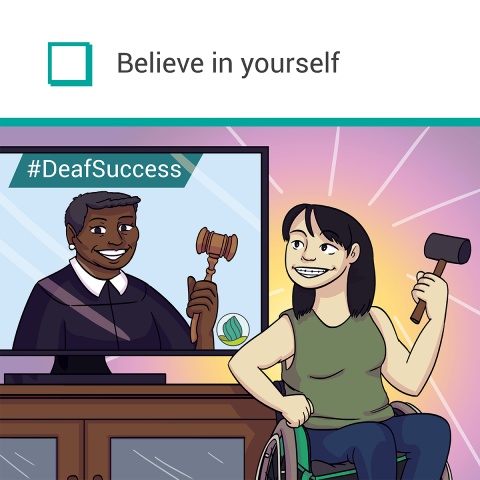
Encourage deaf youth to believe in themselves
Role models are valuable — deaf youth benefit from learning how deaf adults navigate barriers to succeed at school, work, and in their personal lives. Many online resources are available that share stories from deaf adults. Check out #DeafSuccess videos and #DeafAtWork stories from National Deaf Center, #DeafAtWork videos from National Association of the Deaf, and #RealPeople from DPAN.TV.
Additional Resources
For families:
- This resource shares tips for strengthening self-determination at home among deaf teens, while this resource has tips that are applicable to all teens.
For teachers:
- Use the self-determined learning model of instruction (SDLMI) to improve teaching practice and strengthen students’ self-determined actions.
For vocational rehabilitation counselors:
- This Pre-ETS guide addresses instruction in self-advocacy and suggests additional resources about self-determination.