

Cawthon to Present at 2019 OSEP Leadership Conference on Research-to-Practice Connections

Published on July 18, 2019

This looks like an image clicked during a conference, it looks like some audience member looking towards a presentation. Their room seems to be a bit dark.
National Deaf Center Director Stephanie Cawthon, Ph.D., will present at the U.S. Department of Education’s 2019 Office of Special Education Programs (OSEP) Leadership Conference in Arlington, Virginia, on July 22-24. Her presentation, Closing Education Gaps for Deaf Students: Improvement Science and the Research-to-Practice Connection, illustrates how the National Deaf Center uses a coherent, multidimensional approach to support states and other stakeholders in the development and implementation of accessible programming for deaf youth to help them achieve educational and employment success after high school. Using summer programming as an example, Dr. Cawthon explains how the process began with the National Deaf Center’s Engage for Change | state (EFC | state) initiative, which is an intensive TA model that emphasizes the importance of cross-agency partnerships, strengthening systems, and reducing barriers for deaf youth. Learning from EFC | state members that high-quality summer programming is a shared interest across many states, the National Deaf Center uses improvement science to provide the necessary practical support in four key steps:
  • Research Summary: Deaf Youth and Summer Programs: The Why and How was published to explain why summer camps and other programming are important for deaf youth, to serve as an advocacy tool for stakeholders seeking funding, and to identify focus areas for programming content.
  • Deaf Community Interviews: The National Deaf Center collected summer camp stories from deaf people, who explained the impact such programming had on them. These compelling videos show the nuances that are important to remember when serving a diverse population.
  • Interviews of State Agency Colleagues: Experienced state and national leaders contributed their perspectives and insights on how to launch and sustain accessible summer programming.
  • Online Learning: The National Deaf Center has launched an online course, Developing Summer Programs, to facilitate peer engagement and synthesize all of its resources. This class includes opportunities to collaborate with state and national leaders and develop measures for success.
Taken together, this example illustrates how National Deaf Center resources and activities are linked to represent a coherent, multidimensional approach to supporting states and other stakeholders in making the research to practice connection. The 2019 OSEP Leadership Conference in an opportunity for state and agency leadership to learn from experts in the field, strengthen partnerships with peers, and enhance leadership roles to improve results for infants, toddlers, children, and youth with disabilities and their families. Dr. Cawthon’s presentation is on Monday, July 22, at 1:30 p.m. in the Sky View room of the Crystal Gateway Marriott. Get conference updates on Twitter by following Dr. Cawthon (@swcawthon), the National Deaf Center (@nationaldeafctr), or the hashtag #DeafSuccessInEveryState.
Save This
Please login to bookmark Close
Tags: deaf education, Department of Education, online learning, OSEP, research to practice, RSA, Stephanie Cawthon, summer camps, summer programs, technical assistance

Other News Items

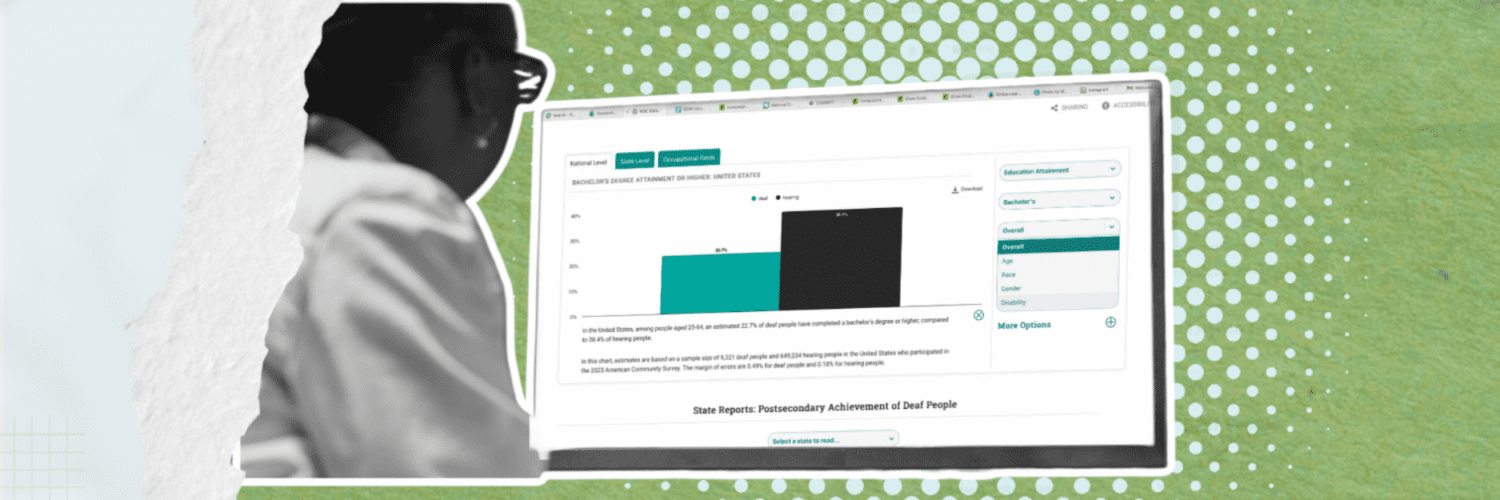
The image shows a composite design with two main sections. On the left, a grayscale side view of a person wearing glasses and looking towards a computer screen, mostly obscured by a textured white overlay. This side is relatively blurred, focusing attention on the right side of the image. The right section features a clear, detailed view of a computer screen displaying a statistical bar chart. The chart is composed of two vertical bars—one teal and the other black—indicating a comparison between two groups, labeled "Deaf" and "All." Numerical values "18" for "Deaf" and "31" for "All" are marked on the bars. The background is green with a dotted white pattern, adding a textured look. A small NDC icon is visible at the lower left corner.
March 16, 2026
Research and Publications, Current Trends
...NDC’s updated Data Dashboard reveals record deaf employment gains alongside persistent workforce gaps, guiding transition supports that expand access to meaningful careers....
A person sits at a marble desk working on a laptop beside an open design book showing color swatches and sketches. Their hands, decorated with henna and colorful nails, rest on the keyboard. A notebook and pen lie nearby, suggesting a creative or design-focused workspace.
November 12, 2025
Online Learning
...Two new NDC modules help campuses strengthen notetaking systems and train notetakers to better support access for deaf students....
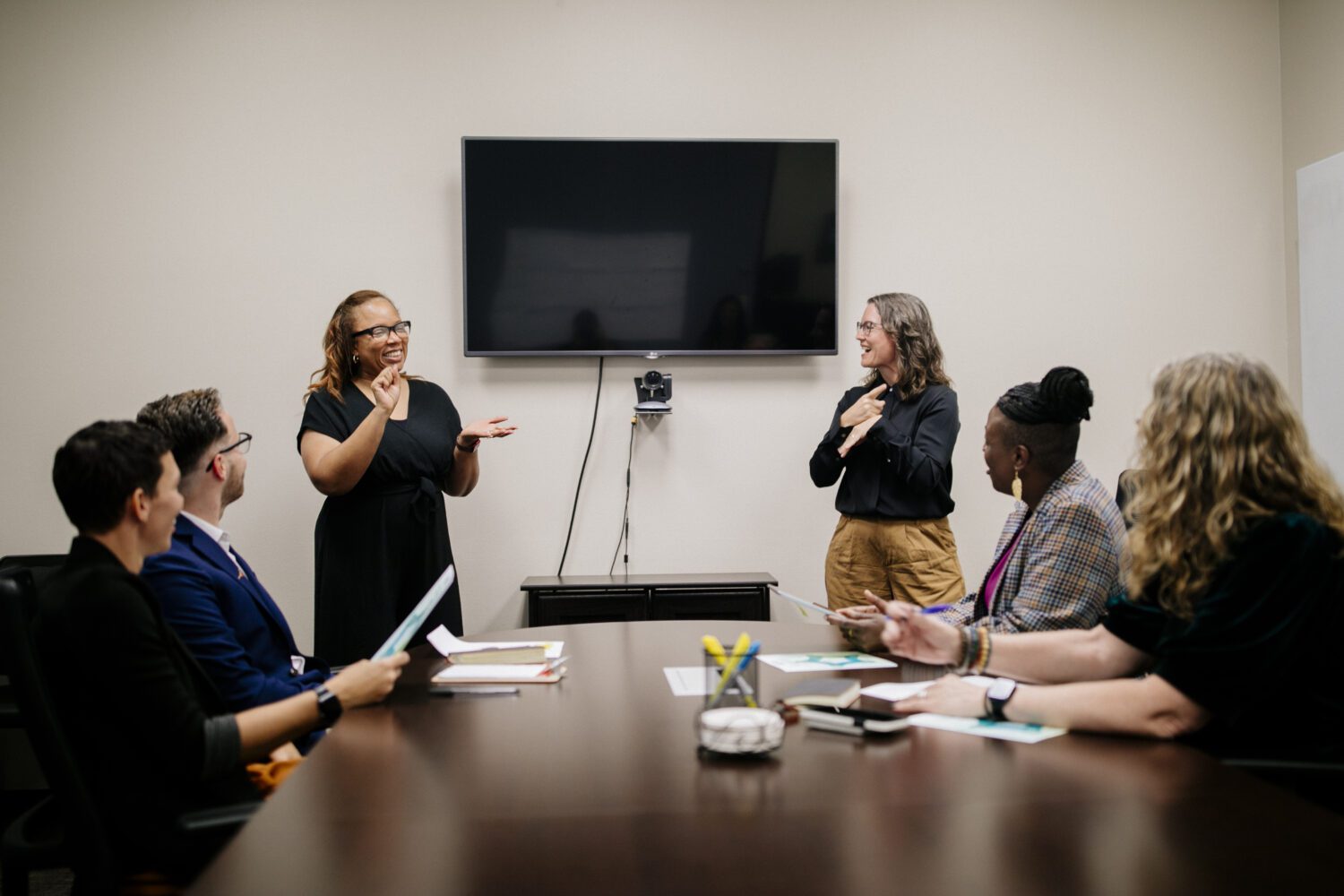
A group of seven people are in a professional meeting room. Two women stand at the front of the room, smiling and communicating in American Sign Language (ASL). One woman, wearing a black dress and glasses, is signing while the other, in a black blouse and tan pants, signs back. Behind them is a large flat-screen TV mounted on the wall above a webcam. Five others sit around a long conference table, watching and engaging with the presenters. The table has notebooks, pens, and documents, and the mood appears collaborative and positive.
November 10, 2025
Impact Stories
...Deaf professionals strengthen campus access systems—but too often, they face the same barriers they’re hired to remove....

Need Help?

Fill out this form to get help from the NDC team.  Can’t see the form below? Click here to contact the NDC team.

National Deaf Center